A built-in pause for engineered T cells
A short protein motif recruits a natural shedding mechanism to regulate CAR signaling and preserve cell function in preclinical studies.
Read the article →A practical guide to biological questions, experimental systems, controls, outcomes, and the limits of a result.
Before looking at a striking image or result, identify what the researchers were trying to distinguish. A paper may ask how a biological mechanism works, whether a measurement method is reliable, or whether an intervention can be delivered safely. Those questions need different experiments. The title and abstract are useful starting points, but the design and measured outcomes define the actual claim.
In a cell atlas, the immediate goal may be to characterize differences between cells. In a functional genetics study, the goal may be to test whether changing a candidate sequence alters a particular cellular readout. Neither result, by itself, establishes a treatment.
Ask which cells, tissues, organisms, or patients were studied. A human-cell model can make a developmental event accessible without recreating a whole person. Mouse experiments can incorporate tissue distribution and a living environment while retaining important differences from human disease. A clinical cohort introduces eligibility criteria, treatment histories, and follow-up that also shape interpretation.
The sensory-assembloid paper studies communication across linked neural components. Its measurements are meaningful evidence about the modeled pathway. They do not establish subjective pain. Naming the system precisely lets a reader appreciate what became measurable while keeping the conclusion within the experiment.
Many measurements do not necessarily mean many independent biological samples. Thousands of sequenced cells may come from a small number of animals or donors. Several images may show the same culture, and repeated measurements may follow the same participant. The paper should make clear which units were independently sampled and how observations were combined.
Read the figure captions and methods for the number of donors, animals, cultures, or participants. These details help explain the scope of a comparison and whether variation between biological samples was represented. The number of cells in a visualization is a different fact from the number of independent organisms behind it.
Separate observation from intervention. An expression pattern can nominate a candidate gene. Altering that gene and measuring a change can test its contribution. A rescue experiment, where feasible, may strengthen the proposed mechanism by asking whether restoring a function reverses the phenotype. Complementary assays can address alternative explanations.
The inherited-cancer-risk study moves from a broad reporter screen to closer tests of a regulatory sequence in its genomic setting. The RNA-localization study experimentally changes where a message travels. These interventions ask more specific causal questions than an association or an image alone, while still depending on the model and readout used.
Tumor volume, cell killing, neuronal activity, neurite outgrowth, and functional recovery are different outcomes. A favorable result on one should not silently become a claim about another. The spatial-RNA study is a useful example: the effect depended on the RNA target and the assay, and more protrusions were not interchangeable with better regeneration.
Clinical interpretation needs the same care. In an early cell-therapy trial, manufacturing feasibility and dose-limiting adverse effects can be primary results. Tumor responses can be important observations while comparative survival benefit remains unresolved. Ask what comparison group was available and what follow-up supports a claim of durability.
Use the original publication date when judging recency. An author manuscript may become publicly available after the journal article appeared; a news story may also be published later. Check whether the item is a peer-reviewed paper or a preprint, and whether a correction changes the version being read.
Affiliation is also specific. Some studies are Stanford-led; others involve a Stanford researcher in a wider international collaboration. This library records those connections alongside the primary paper and distinguishes contextual photography from a study figure. The citation, evidence notes, and method guides are routes into the research rather than substitutes for its full details.
A short protein motif recruits a natural shedding mechanism to regulate CAR signaling and preserve cell function in preclinical studies.
Read the article →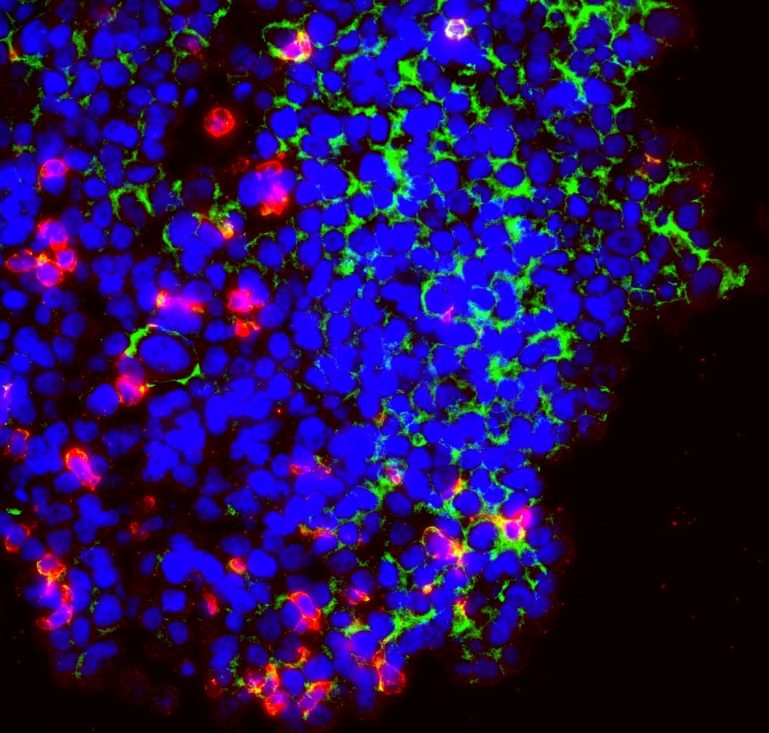
A Stanford team used genetic screens to equip cancer-killing cells with receptors that follow metabolic signals into tumors.
Read the article →
SDR-seq pairs targeted genomic sequencing with RNA measurements in the same cells, helping connect precise variants to cellular behavior.
Read the article →